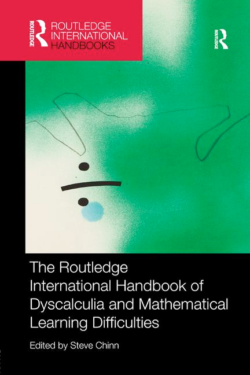
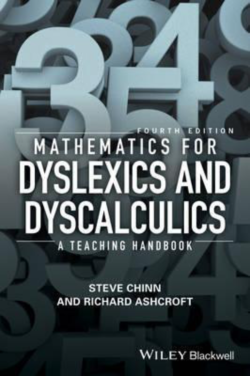
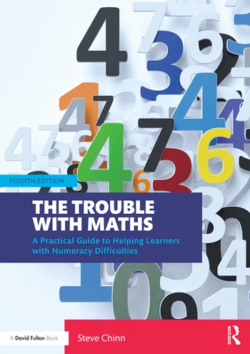
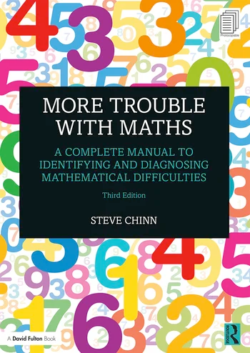
I have written a range of materials for maths including books, worksheets, a test of thinking style and many papers. My book, 'The Trouble with Maths', won a major SEN award in 2004.

NEW BOOK

Worksheets Plus Set
From the Foreword by Professor Maggie Snowling: ‘This is an astonishing book! It should be on the shelves of all professionals in the field of maths education and educational assessment.’

ISBN 978-0-415-67013-5

‘More Trouble with Maths’ includes photo-copiable norm-referenced tests.


WORKSHEETS

Worksheets Plus Set
The eight book set of Worksheets Plus are once again in print.
They are available from SEN Marketing

Although Worksheets Plus have been written around the syllabus for Years 4 and 5, they are designed not to be age-specific in appearance. Thus they can be used for intervention for older students, especially as they cover many of the key topics needed for progress in numeracy. The 'Plus' refers to the guidelines given with each book as to the problems that each topic may create for a learner and an overview of the approaches that may be helpful in addressing these problems. The Worksheets have been designed to address one topic at a time, to be uncluttered and manageable and to help the devlopment of maths skills and knowledge.


PAPERS AND CHAPTERS

I have written chapters for several books including:-

My paper on the survey into maths anxiety in students aged 11 - 17 years (2000+ in mainstream schools and 400+ in specialist dyslexia schools) has been published in Wiley's journal, Dyslexia.

I have contibuted a chapter to the forthcoming Sage publication "Special Educational Needs" co-edited by Gavin Reid and Lindsay Peer.


TESTS

One of my current projects is to develop a diagnostic test battery for maths learning difficulties and dyscalculia. The initial versions have been trialled and modified. I am now collecting data for standardisation. The resulting book will be published Spring 2012 by David Fulton/nasen under the working title of "More Trouble with Maths: Assessing and Diagnosing Maths L.D. and Dyscalculia".


BOOKS

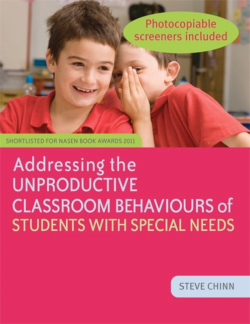
Addressing the Unproductive Classroom Behaviours of Students with Special Needs

My new book, ‘Addressing the Unproductive Classroom Behaviours of Students with Special Needs’, Jessica Kingsley, 978 1849 050 500
was published on January 15th 2010. This book, a departure from my usual maths books, is based on research done with colleagues in Ireland and the Netherlands.

All the author's royalties will go to the Majika school, Hazey View, South Africa. This book was short-listed for a nasen award in 2011


What to when you can't Set

The 'What to do when you can't' titles published by Egon Publishers Ltd have been re-written, updated and three more titles have been added to the series:

  • WTDWYC Add and Subtract
  • WTDWYC Learn the Times Tables
  • WTDWYC Multiply and Divide
  • WTDWYC Tell the Time
  • WTDWYC Do Fractions, Decimals and Percentages

These highly accessible books are written for parents, older pupils, students and adults and offer a non-patronising, consistent and developing pathway through basic arithmetic. The 'What to do when you can't" series are available from Egon Publishing


The Trouble with Maths cover

The Trouble with Maths: A Practical Guide to Helping Learners with Numeracy Difficulties. Steve Chinn. Pub RoutledgeFalmer, ISBN 0 415 67010-4.
The second edition was published in August 2011.

REVIEW of first Edition: From the Association of Teachers of Mathematics
The ten chapters and five appendices are packed with common sense wisdom and insights. It claims to be able to be used to:

  • identify a problem
  • understand possible reasons for a problem
  • develop flexible thinking skills
  • pre-empt problems
  • circumvent problems in basic numeracy
  • address the difficulties pupils have with word problems
  • teach alternative strategies for accessing basic facts
  • recognise mathematics anxiety, attributional style and self-esteem problems
  • design informal diagnostic procedures
  • extract diagnostic information from pupil's work
  • stimulate ideas for teaching maths to pupils who are facing difficulties with the subject

Any book that can do all that is worth its weight in gold! This book provides an excellent starting point for doing all of the above.

At the end of the introductory chapter we are provided with a few golden rules:

  • Don't create anxiety
  • Experiencing success reduces anxiety
  • Experiencing failure increases anxiety
  • Understand your pupils as individuals
  • Teach to the individual within the group… also known as the 'Teach more than one way to do things' rule
  • Remember where each topic leads mathematically
  • Understanding is a more robust outcome than just recall.
  • Try to understand errors ... don't just settle for 'wrong'
  • Prevention is better than cure
  • All the above rules have exceptions

Excellent advice, which I suspect we all know, but it's good to be reminded of it every now and again!

The second chapter looks at factors that affect learning. What makes this chapter so valuable is that as well as analysing the problems (such as short term memory, direction, visual, speed of working, poor recall of facts, poor reading skills, sequencing skills …) there are numerous suggestions that can help alleviate that particular problem.

The next chapter is an overview of the mathematics curriculum and examines where the difficulties may occur. Chapter 4 looks at thinking style in mathematics, notably the contrast between the inchworm (step by step) and the grasshopper (more intuitive, holistic) approaches.

Developmental perspectives and the language of mathematics are dealt with in the next two chapters. Chapter 7 on 'Anxiety and attributions' pulls together many of the themes in the preceding chapters and examines ways we can reduce the anxiety that is so often associated with maths.

Chapter 8 provides a fascinating tour of the inconsistencies of maths. Mathematics, supposedly one of the most logical of subjects is idled with inconsistencies; to illustrate the point Chinn includes an extract from Mathematics Teaching 175 (June 2001) 12-13, on the illogicalness of concepts associated with telling the time.

Assessment and diagnosis is covered in Chapter 9. Here we have a useful checklist for standardised tests and advice on when and how often they should be used. Also examined are the reasons for testing. There is also a useful section on more informal tests using simple materials.

The final chapter deals with 'the nasties', long division and fractions. This chapter pulls together much of the ideas and advice given in the previous chapters and applies it to different approaches in teaching the nasty topics.

There are five appendices, which deal with further reading, resources, examples of memory cards, suggestions for an inclusion policy and criterion referenced tests.

Overall the book provides invaluable help to all those involved in the delivery and support of numeracy, be they parents, teachers, classroom assistants, SEN coordinators, learning support tutors… It may not be the last word on the subject, but it will certainly be an important first place to look

'The Trouble with Maths' won the NASEN/TES award for the Teaching and Learning Book category in 2004


Dealing with Dyscalcula Cover

'The second edition of Sum Hope, re-titled as 'Dealing with Dyscalculia: Sum Hope 2 ' was published by Souvenir Press in September 2007.

The third edition was published in August 2011, re-titled, ‘The Fear of Maths and How to Overcome It’. It has been updated significantly.

Review of the second Edition by "Special, the NASEN magazine"

Dyscalculia is a specific learning difficulty that affects how people deal with number and number-related tasks. It has a significant effect on a person's self-esteem and self confidence, often causing them to give up on mathematics.

This book is an inspirational read for anyone experiencing difficulty with mathematics and for those working with and supporting them. The text is well structured and the ideas are set out simply, making it easily accessible for a wide range of readers. It is particularly encouraging in that it starts from a very basic level, ensuring that even the most profoundly dyscalculic person is not 'put off' by not having enough skills or knowledge to even start the book.

Teachers looking at this book will find that it provides a fascinating approach to helping pupils of all ages to work confidently with numbers. As you work through the book it provides a clear introduction to some quite difficult areas of mathematics, such as decimals, fractions and percentages, and introduces important everyday number skills. Any teacher who reads this book will change the way they approach and teach mathematics, particularly in the early years, and will have pupils who achieve far better and with a greater degree of confidence.

The case studies give an excellent insight into how people with dyscalculia approach mathematical tasks, and illustrate the importance of allowing them to learn in the style that is best suited to them. The first case study, Ann, shows the devastating and life-long effect dyscalculia can have a on a person's confidence and the stress and anxiety it can cause. Some of the case studies make reference to other areas of the curriculum that can be affected by a difficulty with number-related tasks. A second book that addresses this aspect of dyscalculia would make an interesting read.

This book is excellent value for money; no teacher of mathematics should be without it. The only improvement I would suggest is that the inclusion of some colour illustrations would help make some of the points clearer.


Mathematics for Dyslexics
'Mathematics for Dyslexics, including Dyscalculia' (2007) 3rd edition, written with Richard Ashcroft and published by Wiley...... ISBN 0-470-02692-8

This 3rd Edition of the standard work discusses the factors that contribute to the potential difficulties dyslexic learners may have with mathematics, and suggests ways of addressing these difficulties.

The first chapters consider the theoretical background. The later chapters look at practical methods which may help dyslexic learners.

The book is a thorough and comprehensive text for help teachers to help understand the students' needs and to learn a range of skills and thus develop confidence and competence in working with dyslexic pupils.


Books can be ordered direct from the publishers or from

SEN Marketing,
618 Leeds Rd,
Outwood,
Wakefield, WF1 2LT,

Tel/Fax; 01924 871 697